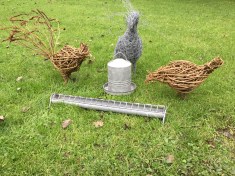
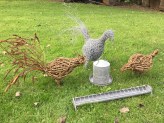
Have a go at chicken wire sculpture and make a cute hedgehog to display in your garden or give to someone as a gift.

This course is aimed at beginners and will teach the basics of sculpturing with chicken wire. The course will run from 11.00-3.00 on Saturday 19th May. 35 Euros per person. A light lunch is included as well as all materials and you will be able to take home your hedgehog.

You will need to wear warm comfortable work clothes and bring some gardening gloves.

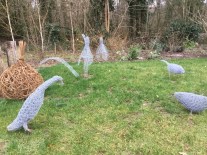
IMG_0162If you enjoy this beginners course we will be offering intermediate courses later this spring to make chicken, cockerel or duck sculptures for the garden.
We will send you confirmation and further information once we have received your payment. If you prefer to send us a cheque please use the enquiry form to reserve a place on the course.

To book onto Saturday 19th May use the buy now button below:

Buy Now Button

If you have any questions or comments about the course please use the enquiry form below

← Back

Thank you for your response. ✨

Warning
Warning
Warning
Warning

Warning.

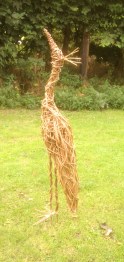
Learn the basics of sculpture using chicken wire to create a lifelike chicken sculpture for your garden. A good basic beginners course which can lead onto building on these skills to create more complex sculptures later in the year. IMG_0526

This full day course will run on Thursday 24th May from 10.00-4.00 including a short break for a light lunch and refreshments. Materials and refreshments are all included. 55€ per person.

You will need to wear work clothes and bring a pair of sturdy gloves. Chicken wire is a malleable material and easy to use but will require moderate strength in your hands and fingers.

To book onto the course please use the ‘buy now’ button below. If you have any questions or comments please use the enquiry form below. If you prefer to pay by cheque please use the enquiry form to reserve a place on the course.

Buy Now Button

For enquiries:

← Back

Thank you for your response. ✨

Warning
Warning
Warning

Warning.

WP_20150626_13_02_52_ProOnions are well worth growing and pretty easy  as they do not suffer from many pests and diseases. However, they are prone to bolting in dry weather which can be a problem in a typical summer in France.

It is a good idea to buy onion ‘sets’ rather than growing them from seed; sets are immature onions, part grown and then dried and stored in a dormant state. They have usually been given ‘hot water treatment’ which can help to kill off any diseases and prevent bolting. (bolting is the term used to describe early production of the flower which will make the bulb unsuitable for storing and reduce the yield considerably). Sets not only give you a head start and therefore a longer growing season but are easier and more reliable than growing from seed.

This very cold wet start to the year means that for most of us the soil is still far too wet and cold for sowing or planting but you can get your onion sets off to a good start by planting them into trays of modular cells or seed trays. This will endure that a good root system has developed before you plant them out into the soil and that the sets are viable. It can also help to prevent birds or rodents from disturbing the newly planted sets, without roots they are easy for them to steal!

They don’t need any warmth or protection – a cold frame, unheated greenhouse or polytunnel or just a sheltered spot in the garden. After about 3 weeks the shoots will be about 5-10cm long and ready for planting out in rows at about 15cm apart. You can start garlic and shallots off in the same way.

Before planting make sure that you have added plenty of well rotted organic matter to the soil to retail water and therefore helping to give the onions an even supply over the summer. If necessary you can irrigate using a seep hose laid alongside the row, keeping the soil moisture topped up by watering in the evenings when necessary. This will deliver water directly to the soil. Onions need a regular water supply to swell to full size and can split and rot if a period of drought is followed by heavy rain or watering so managing the irrigation is important.

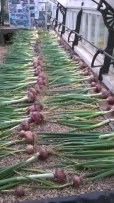
Onions are ready to harvest when the tops have dried out and tumbled over, lift the onions on a dry day and allow to dry out on well aired racks in the sunshine for several days before storing. Onions should be stored in a light, airy and frost free place – keeping them in the dark will induce growth. You can plait them into strings or hang them in onion sacks.

This slideshow requires JavaScript.

Learn the basics of dying fabric using natural plant based dyes and ‘printing’ using leaves, flowers and rust printing.

We will look at the principles of dying silk fabrics and you will create a unique hand printed silk scarf to take home.

Thursday 31st May 1-4pm 30€ including materials.

Please use the ‘Buy Now’ button below to book a place on the course. If you have any enquiries you can use the contact form below at the bottom of the page:


Buy Now Button

← Back

Thank you for your response. ✨

Warning
Warning
Warning

Warning.


SDC14930Learn the basics of organic gardening starting with the key principles of building soil fertility using natural methods and organic pest and disease control, basic practical techniques and tips on how to be successful and how to avoid key problems.

You will have the opportunity to test your own soil, get SDC14932answers to your questions and see an organic system in practice as well as learning the basic theory. Plus you will have a choice of free heritage and heirloom bean seeds to take away and grow.

Thursday 10th May 10.00-3.00 40€ including light lunch and refreshments.

Use the button below to book your place on this course. If you have any questions please use the enquiry form at the bottom of the page.

Buy Now Button

← Back

Thank you for your response. ✨

Warning
Warning
Warning

Warning.

IMG_0428Greenwood crafts: Use a traditional pole lathe to turn a dibber or a string line. 10.00-4.00 either Thursday 8th March or Saturday 10th March. 35 Euros per person including materials and light lunch: Greenwood crafts info and booking
IMG_0399Introduction to Tree identification Learn the basics of plant identification and get to know some common trees in winter to enhance your enjoyment of your garden and the surrounding countryside. 17th March 20 €: Tree Identification info and booking
Tool maintenance: learn how to service and sharpen your hand tools. 22nd March or 24th March. Bring along your secateurs, loppers, axe, shears etc. 2 hour session 20 €: Tool maintenance info and booking 
Make a bird box or bird table: be creative and make a quirky bird box or feeder. 12th April 10-2.30 35€ inc materials and light lunch: booking form coming soon
IMG_0090

Willow weaving: learn basic weaving skills and weave an ‘acorn’ lamp for your summer garden 14th April 35€: Willow lantern info and booking


Garden design: Learn the principles of garden design, garden surveying and planting plans and create a design for your garden. 2 days 26th April /3 May 80€: Garden Design info and booking
Chicken wire sculpture: Create a chicken in wire for a bespoke garden feature. 28th IMG_0520April 10.00-4.00 55€ inc materials and light lunch: Chicken sculpture info and booking


Watch this space for details of forthcoming courses: eco-printing, dye your own silk scarf using plants and natural dyes, organic growing, willow sculpture, Basic botany

Learn the basics of sculpture using chicken wire to create a lifelike chicken sculpture for your garden. A good basic beginners course which can lead onto building on these skills to create more complex sculptures later in the year. IMG_0526

This full day course will run on Saturday 28th April from 10.00-4.00 including a short break for a light lunch and refreshments. Materials and refreshments are all included. 55€ per person.

You will need to wear work clothes and bring a pair of sturdy gloves. Chicken wire is a malleable material and easy to use but will require moderate strength in your hands and fingers.

To book onto the course please use the ‘buy now’ button below. If you have any questions or comments please use the enquiry form below.


Buy Now Button

For enquiries:

← Back

Thank you for your response. ✨

Warning
Warning
Warning

Warning.

Helleborus orientalis is a very variable species that will self-seed readily and will

IMG_0169
Floating hellebores

produce a wide range of flower colours and shapes in its offspring, it also hybridises freely and the resulting Helleborus x hybridus are equally variable. You will often see different variants and hybrids offered for sale as unnamed varieties and this is because they are grown from seed and each individual can be distinct from others within a batch of seedling plants, there are far too many attractive variations to name them all. If a particularly attractive seedling is to be named and sold as a cultivar it must be cloned (vegetative propagation such as cuttings and division). This is a lengthy process because it takes several years for a clump to reach a large enough size for dividing and Hellebores dislike disturbance. They do not produce stems with nodes so cuttings are not possible.
Named cultivars are often expensive because of this process but the desire for double flowers, dark purple to black and upward pointing flowers is such that plants that display some or all of these characteristics are sought after and therefore worthy of the process.
Helleborus are typically under story plants and are at their best when planted in natural drifts under trees and shrubs to give an early display of ground cover, they complement early spring bulbs and other winter interest herbaceous perennials such as Arum IMG_0536italicum ‘Marmoratum’ and thrive in humus rich, neutral to alkaline soils in shade or semi shade. They do best in a moisture retentive soil but can cope with dryer soils as long as they are not in full sun.
The leaves are evergreen but leaves from the previous season should be cut off at ground level in mid-winter just before the flower buds start to develop. You will then benefit from a stunning display of flowers that are not hidden by the tatty older leaves, new leaves will start to grow as the flowers fade. Division can take place every 5-8 years in autumn but don’t be afraid to let them self-seed or save some of the developing seeds and cultivate them, sow in autumn but don’t treat them too kindly, they need exposure to cold over the winter in order to break the dormancy and they will then readily germinate in spring.

IMG_0172Hellebores do not make great cut flowers because the stems soon flop and the real beauty of the flowers is mainly hidden on the inside but you can snip off just the flowers and create a stunning floating display as a table centre piece which lasts longer than the cut stems.

Learn basic willow weaving techniques and create a stunning ‘acorn’ lantern for your garden, summer house or home by adding some fairy lights.

This half day course runs from 1.00-5.00 with a short break for refreshments (included)

IMG_0092You will create your own lantern to take home with you (all materials for the willow lantern are included in the cost) Add your own battery powered or solar lights to create a unique and subtle outdoor light.

This is a good beginners piece for anyone who wants to learn willow weaving or willow sculpture. More advanced courses will be running later  in the year.

You will need to wear comfortable ‘work’ clothes and bring a pair of light gardening gloves. Willow is a flexible material but moderate strength and dexterity in your hands and wrists are beneficial. We can help you if necessary.

14th April 1.00-5.00pm 35€ per person

Please use the buy now button below for booking onto the course and the enquiry form if you have any questions:


Buy Now Button

If you have any questions or comments please use the contact form below:

← Back

Thank you for your response. ✨

Warning
Warning
Warning

Warning.


Here at Le Jardin Creatif we have been busy setting up our sister enterprise ‘La Petit Pépinière de la Guinandie. The high rainfall in January has slowed down our progress on getting all of our polytunnels and structures up but we have managed to make a start.

Watch this space for more details about when we will be fully opening the nursery but in the meantime we have lots of potted bulbs ready for sale. Now is the time for planting out bulbs ‘in the green’ for naturalising and for spring displays in pots and borders. If you missed your opportunity to plant bulbs in the autumn we have a wide range for sale. We will be open Saturday morning 10th February 10.00-2.00 or by appointment if you want to drop by on a different day or time.

Our availability list can be downloaded here: Bulb availability list

Please get in touch if you want to visit by appointment using our contact form

You can find out more about us on our website and we can be found on google maps

Watch this space for more news and plant availability